Who this album is for
For the 90s kid who grew up in the 2000s & 2010s: screen names and away messages, burned CDs with marker handwriting, bikes dropped on front lawns, being called home when the streetlights came on, wired headphones drowning out road noise.
They're around thirty now. Summer is ending — not their last summer, but the kind of August evening where you suddenly notice you've been happy, and noticing already feels like missing it.
The title is our thank-you to that feeling. Still light outside — telling it that the sunset is beautiful, that we look up for the stars that come out at night, and that we know: soon there will be a new dawn.
The emotional thesis
- Nothing in this life lasts forever. Everything is transient — the way the iroha teaches Japan's schoolchildren: the blossoms are fragrant, and they scatter. We internalize this through our music.
- Never lose hope, and do not fall into despair. Even as the summer disappears, there is always a sunrise on the far side of a beautiful night.
- Loss is not forever. This is not our real home — and deep down, the child inside each of us remembers the way back to the beautiful light.
Shared musical DNA
Female lead vocal — clear, youthful, sincere, never theatrical; the supercell trick of a delicate voice over loud guitars. Pop-punk and emo instrumentation: driving eighth-note guitars, octave lead lines, punchy live drums, melodic bass; piano and occasional violin as the nostalgia colors, especially on tracks 2 and 12. Major-key brightness brushes relative-minor shadows. The production is modern but warm — not sterile; a little air and room, like a good 2005 record remastered.
The thirteen tracks
Open a track to read its full direction. The numbers at right follow the album's clock.
01A Song That Starts at the End
Prelude / thesisafter Owari e Mukau Hajimari no Uta“This song starts at the end of the summer” — from the sessions
Sparse: voice + clean guitar shimmer + soft pad. Restrained, reflective. States the thesis: everything you're about to hear is already a memory. About ninety seconds of held breath before track 2 detonates.
02The Story I Never Sent
The masterpiece · first singleafter Kimi no Shiranai MonogatariA major165 BPM“The story I never sent you is still climbing somewhere up there” — from the sessions
Piano + voice open, then the band tears the roof off. Unsent-message love: the confession typed into a screen-name window in 2006 and never sent, remembered under this August's night sky. Long climbing vocal phrases that reach past comfort. Summer Triangle imagery, seen from a suburban roof. Devastating and bright at once.
03Backyard Hero
Light youthful popafter Hero“Tomorrow, definitely tomorrow” — from the sessions
Buoyant, conversational pop punk. Small emotional scale: a crush, a bad haircut, borrowed courage. Thoughts escaping faster than they organize. A breather that stays in-world.
04Chasing Contrails
Remembered childhoodafter Perfect Day“Nothing up there is out of reach, it just hasn't been reached” — from the sessions
Open, spacious, optimistic mid-up-tempo. Walking the road markings, chasing contrails, believing you could reach them. Rising melodic gestures. The ache is embedded, not stated: you only recognize the believing after it's gone.
05Get Even
The teethafter Fukushū“Okay, fine, I'm mad” — from the sessions
The album grows fangs: harder, faster emo-punk, aggressive rhythmic attack, the delicate voice pushed into a snarl. Humiliation, jealousy, revenge fantasy — theatrical, a persona, almost fun in its fury. Necessary so the album isn't uniformly pretty.
06Garage Band Forever
Release valveafter Rock 'n Roll Nandesu no“Nobody came to the show, so the show is ours” — from the sessions
Exuberant, cheeky, knowingly excessive rock'n'roll through a pop-punk lens. Physical, not contemplative. Converts track 5's anger into movement: three chords in someone's garage, hairbrush microphones, glory.
07Night Drive (Windows Down)
Nocturnal electronicafter LOVE & ROLL“Home is just the long way if you take it right” — from the sessions
Palette shift: synth-forward electro-pop-punk, groove-centric, urban and artificial. Cooler vocal — performing confidence instead of confessing. Gas-station neon, someone's hand out the window. Slightly more adult air.
08Screen Door Summer
Breezy present tenseafter Feel so good“Barely, but it counts” — from the sessions
The easiest track to inhabit. Relaxed, warm, immediate happiness — no distance between singer and experience. Melodically still restless, with long wandering phrases; emotionally at rest. The calm before the descent.
09Perseids
Starry hopeafter Hoshi ga Matataku Konna Yoru ni“The whole sky is a memory the Earth is driving through” — from the sessions
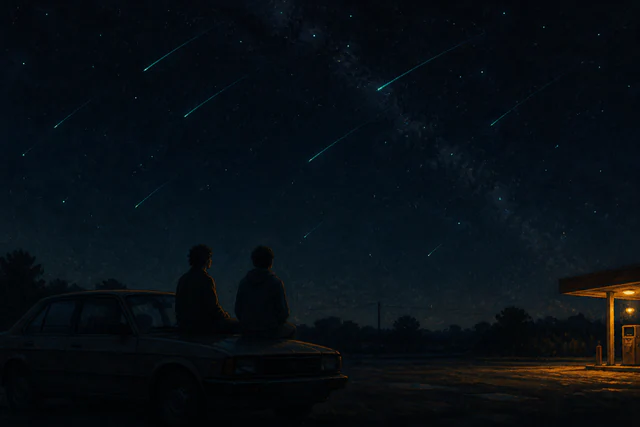
Back to the night sky — it's mid-August, the Perseids are real. Romantic, expectant: something might happen tonight. Where track 2 says “I couldn't tell you,” this says “maybe I still can.” The turn from recollection toward farewell.
10Sparklers Going Out
The elegyafter Utakata Hanabi“It's beautiful because it doesn't last” — from the sessions
The slow one. Space after all that propulsion. Fragile exposed vocal, supportive arrangement. End-of-summer fireworks: silence → anticipation → burst → decay → dark again. The album stops disguising that beautiful things end. Pure mono no aware in emo-ballad form: beautiful because it disappears.

11The Sky Gets Light
Dawn transitionafter Yoru ga Akeru yo“And it's beautiful, and it means going home” — from the sessions
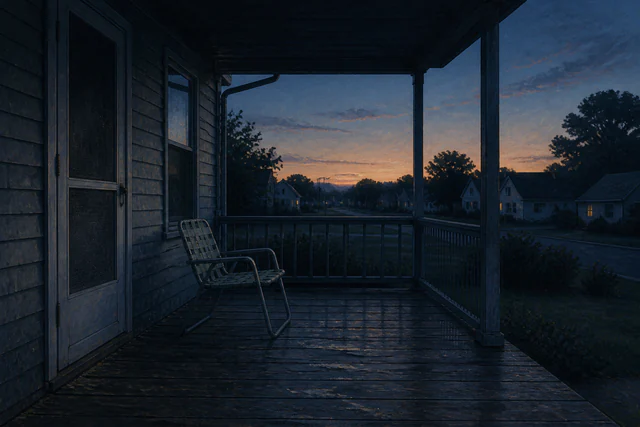
Transitional, not climactic. After the all-nighter: sunrise is beautiful and it means going home. Melancholy acceptance beginning to move forward. Mid-tempo, gathering.
12Say It Before September
The true finale · second singleafter Sayonara MemoriesB major160 BPM“It was always you — I'm saying it out loud” — from the sessions
Piano + voice open, expand outward — deliberate structural mirror of track 2, with violin as the nostalgia color. Last week of summer as graduation day: boxes, photographs, everyone laughing while a world quietly disappears. And this time she says it — the confession track 2 never sent finally gets spoken before the present becomes another regret. The sadness runs.
13To Myself, From August
Epilogueafter Watashi e“It's still light in me” — from the sessions
The camera turns inward. Intimate, understated, mirroring track 1's quiet — circular architecture. The party's over, the sparklers are dark, everyone went home. A letter to oneself: carry it forward. Ends the album on held warmth, not catharsis.
The pressing plant
MiniMax released Music 3 as an open-weight model, and we pulled the repository the day it landed. Day one assumed CUDA: no MLX, no MPS, no road laid across Apple silicon. So we laid one ourselves, first teaching the released pipeline to survive on a 64 GB M1 Max, then carrying that work forward until an Apple-native implementation was merged upstream. The first long local performance asked for 342 seconds of music and returned 237.47 seconds after 7,414.95 seconds of inference — two hours, three minutes, and thirty-five seconds — with a 71.1 GB process footprint and roughly 41 GB of cumulative swap-out writes.
Then we shaped the pipeline for the machine instead of asking the machine to pretend it was a server rack. Staged loading cut that footprint from 71.1 GB to 31.13 GB and stopped render-caused swap-outs; the finished hybrid path held about 22.03 GB. On the same 15-second, 30-step gate, wall time fell from 346.8 seconds in staged PyTorch/MPS to 244.8 in native MLX, 237.9 after restricting the semantic head from 200,000 rows to 16,385, 199.5 with component-specific precision, and finally 178.4 — 2:58.4 — with batched guidance.
Every one of those numbers had to answer to a pair of ears. A 20-step shortcut cut 217.5 seconds to 178.3 but left audible distortion; an RVQ depth cache cut 237.9 to 217.5 and came back off-key and garbled. Both were struck from the pressing. Batched guidance stayed because it saved 10.6 percent of wall time, measured 94.47 dB difference SNR against the reference, and still passed a human listening gate. A metric cannot hear. A change survived only when the render got faster and a person still loved what came out; the failures stayed in the ledger.
The long-form program climbed by guarded rungs: 15, 60, 120, then a 180-second ceiling, with checkpoints after the semantic pass and every acoustic window. The approved E-flat take passed its 60-second gate in 13:57.4, continued to 120 seconds in 28:22.1, and finally found a natural ending at 172.70 seconds in 41:32.4. It held 101.12 BPM, wrote zero swap-outs, and could resume after interruption without changing a byte of the finished audio.
These thirteen tracks were rendered through the hosted service while that local press was being built. And now the machine on the desk can do it too: music made completely offline, in a bedroom, from a feeling and a few words. That is the Baiograph promise made tangible — a tool from the future that can carry those feelings into any genre, with the craft of singers, bands, and sound engineers close at hand.
The motif map
Amber holds the human signals: streetlights, unsent words, the route home. Meteor teal is reserved for the things that cross the sky and are gone.
Lineage
Today Is a Beautiful Day, released in 2011, belongs to supercell's yanaginagi era: a record whose bright surfaces and enormous melodic climbs carry an exact, difficult melancholy. Still Light Outside adapts that emotional architecture because its tensions remain worth inhabiting — while every melody and lyric here is original.